The Challenge
On paper, the workflow was straightforward: take a product URL from the retailer's website, extract the specifications, find matching suppliers, request quotes, and negotiate pricing. In practice, the project became a much deeper automation challenge due to aggressive bot protection, inconsistent page layouts, popups, ads, changing inquiry flows, and supplier conversations that often happened inside marketplace inboxes rather than through normal email.
That meant the real complexity was not in building the initial workflow, but in training and refining the AI to reliably navigate unpredictable interfaces and adapt to the different ways suppliers respond. It also became clear early on that this would not be a "set and forget" system, but an automation that would need ongoing tuning as the marketplaces changed their behaviour.

The Solution
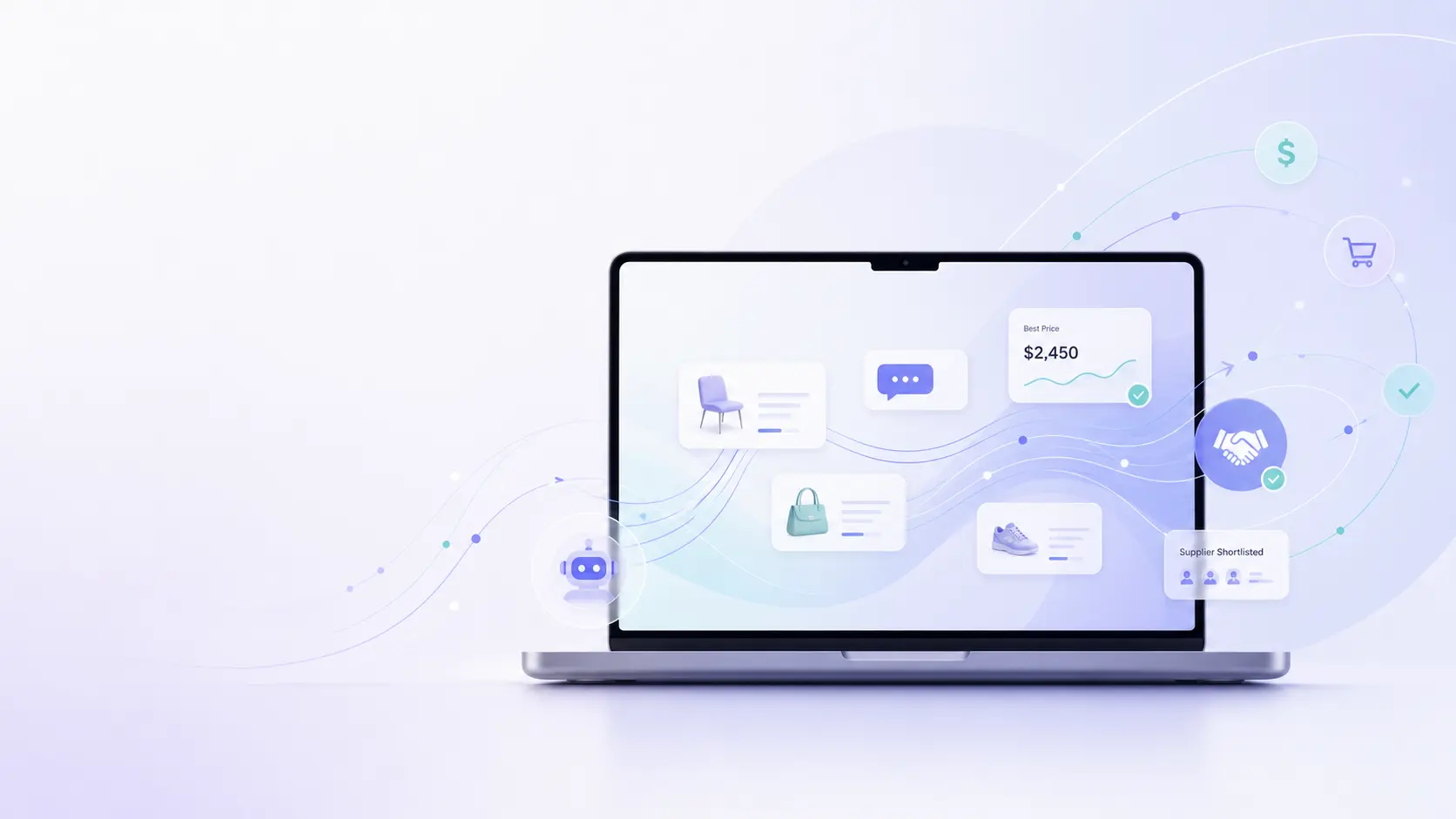
The final solution was designed as a mostly autonomous sourcing pipeline. A user adds a product URL into a shared input sheet, and the system picks it up on a schedule, extracts the relevant product details, searches two major international ecommerce marketplaces for similar products, and submits supplier inquiries in controlled batches to reduce the risk of bot detection.
Each outreach is logged to a sourcing database, creating a live record of which suppliers were contacted, what product they were matched against, and what stage the conversation has reached. As replies come in, an AI triage layer reviews the message, filters out junk or irrelevant responses, determines whether the supplier is suitable, and decides whether the next step is clarification, negotiation, or human review.
When a supplier reply requires follow-up, the system drafts a response, updates the record, and sends the next message at the appropriate time. Where suppliers communicate through marketplace inboxes rather than email, the automation returns to the ecommerce store itself and sends replies through the native messaging interface, ensuring the conversation continues in the channel suppliers actually use.
Tech stack
Workflow in Practice
The system is now able to run end to end with only two human touchpoints: adding new product URLs at the start, and stepping in at the end once a supplier has reached a firm negotiation point. Everything in between - product extraction, supplier search, inquiry submission, response handling, negotiation logic, and status updates - is automated.
To keep costs under control and reduce detection risk, activity is intentionally throttled rather than pushed at full scale. Even with those limits in place, the workflow has already been tested successfully using dummy inquiries from start to finish, and live supplier conversations have progressed into active negotiation.
Key Challenges Solved
One of the biggest hurdles was that supplier email notifications often came from no-reply addresses, which meant a standard email automation could not continue the conversation. The workaround was to extend the system so it could log back into the ecommerce store, locate the relevant supplier thread, and respond directly inside the platform instead.
Another challenge was that suppliers often send multiple short messages rather than one complete response, and sometimes include images or attachments that are not visible in the notification itself. To handle that, the automation had to be structured to retrieve additional context from the conversation before deciding how to reply, which added significant complexity but made the system far more reliable.
Outcome
This project proved that supplier sourcing and early-stage negotiation can be automated in a practical way, even in environments with strong anti-bot protections and inconsistent communication flows. The finished system gives the retailer a repeatable process for testing supplier pricing, reducing manual back-and-forth, and keeping procurement activity visible in a structured format that humans can step into only when needed.
It also highlighted an important architectural lesson: the browser automation itself was only one part of the solution. The real value came from combining AI-driven decision making, structured workflow logic, and a persistent sourcing database into a system that could tolerate messy real-world behaviour and still keep moving.
Frequently asked questions
Can AI really negotiate with suppliers?
The AI in this pipeline handles structured negotiation: it drafts responses, decides whether the next step is clarification or an offer, and keeps the conversation moving within the rules the team sets. Complex or high-stakes deals route to a human. The AI manages the volume, the human manages the judgement.
Is AI in procurement just for big retailers?
No, the pattern scales down. The core pieces, a source of truth, a workflow engine, and an AI layer for triage, are the same for a business of twenty as for one of two thousand. The difference is volume, not architecture.
How long does a setup like this take to build?
The first version of this pipeline took weeks, not months, and the ongoing tuning is what makes it reliable as the marketplaces change their behaviour. Anyone promising instant set-and-forget automation should be treated with suspicion.
Key takeaways
- Automation wins when humans only do the thinking. The biggest gains came from stripping out all the repetitive work and reserving humans purely for judgment calls on products and deals.
- Smart orchestration beats "just add AI." The system works because AI is wrapped in clear stages, routing, and state tracking, turning messy marketplaces into a predictable pipeline instead of a clever one-off bot.
- Real-world mess is a feature, not a bug. Designing for popups, anti-bot rules, no-reply emails, and fragmented chats from day one makes the automation more resilient and more valuable than any "happy path" prototype.